Li: ritual, propriety, etiquette. Hsiao: love within the family (parents for children and children for parents. Yi: righteousness--the noblest way to act in a situation. Xin: honesty and trustworthiness. Jen: benevolence, humaneness towards others. Chung: loyalty to the state and authority. --Confucius (Kong Fuzi)

All articles appear in reverse chronological order [newest first].

Post from FaceBook may not be viewable if not signed into FaceBook.
I believe the past is relevant, sometimes more than others of course. In most cases we are seeing history being repeated, so it is most relevant.
Showing posts with label Capitalism/Economy. Show all posts

Saturday, December 11, 2021

NOW IS THE TIME FOR WORKERS TO SECURE LONG-TERM PROSPERITY

Employers are hiring more part-time workers than full-time workers, commonly referred to as a 'gig economy. The whole idea of a 'gig economy' is to eliminate full-time jobs and benefits in order to reduce labor costs.


Those jobs that were shipped overseas decades ago by pro-corporate Republican't policies will never return as full-time manufacturing jobs. They will only return as mechanized and automated jobs.
The reduction in work hours, benefits, wages, and manufacturing jobs, and the whole chain of associated supporting labor will mean that in order to sustain and survive families will have to work multiple jobs by multiple family members.
Self-employment and public welfare will be the only viable option for middle-class families. It will be unsustainable resulting in the destruction of the middle class.
A massive expansion of the welfare system or the establishment of a 'Basic Universal Income' will become the only viable option. This will be a hard pill to swallow for the American working family and it will be aggressively fought by the pro-corporate lobby via their Republican't sycophants who will fight both options without offering any real solution of their own. They will cry 'socialism', 'communism' and"Let's go Brandon" while they fortify themselves in their ivory towers.
Glenn DL
  • Prepare for the Matrix
  • Prepare for Skynet and the terminators
  • Soylent Green is tasty
ent Green is tasty

Friday, February 26, 2021

Fair Trade, Fair Markets, Fair Share Taxes and Responsibility:

reposted from May 2010

by Glenn Littrell

Whirlpool spends 110 million dollars on building a factory in Mexico, resulting in the closing of the Whirlpool plant in Evansville, Indiana. Eliminating over 900 jobs and devastating the community.

Whirlpool is receiving about 19 million dollars in stimulus benefits this year. If their factory is less than 25 years old, I suspect that they received tax breaks to build it. Have they also received tax breaks for unemployment compensation premiums for temporary jobs meant to encourage expansion and hopefully permanent jobs? How much have they tapped into government grants, government loans, and tax breaks over the years? I would suspect that Whirlpool has lobbied for legislation that was favorable to their company as well as their industry, and it wouldn't be a stretch to assume that they lobbied for policies that continue to make it easier to export jobs and close plants, to become importers of foreign goods as opposed to manufacturers of American products. I suspect that they have probably spent millions to support the Chamber Of Commerce and their attack on any 'Buy American' legislation.

Can anyone doubt that they have probably lobbied the Mexican government for Tax breaks and looking the other way on already nonexistent or lax health, safety, and environmental regulations? Bribing corrupt foreign officials is always cheaper than paying your fair share of taxes; just look at how much corporations and industries spend on lobbying every year. 

The only way we could 'entice' them to stay here would be to let them operate tax-free with no safety, health, environmental, wage, or labor regulations and for American workers to take no benefits and a pay reduction to less than a dollar an hour. Only countries with corrupt governments and or an impoverished population could accommodate corporations in this manner, and aren't we already getting too close to that ourselves?

With the "Tea Party" movement crying for their taxes to be reduced and smaller government, where would that leave us? Our infrastructure is already crumbling, schools are declining, and uninsured health costs are rising. These are just some of the many other things that need to be fixed because their cost is growing. 

The idea that free markets and unencumbered businesses will do the right things is idealistic and unrealistic. 

If you want to see Free Markets at their most deregulated, just look at the black market in illegal drugs.

Unrestrained markets lead to unrestrained greed, not because everyone is potentially greedy but because many are. Now that Corporations have been granted free speech rights, maybe we should consider demanding that they take on more civic responsibilities before we end up granting them voting rights or the right to run for elected office. 

Here are some concepts worth considering: 

  • Fair Trade in place of Free Trade, 
  • a Fair Market System in place of Free markets, 
  • a more efficient government instead of larger or smaller government, 
  • and more responsibility, not less from those who benefit the most from the virtues of this country.

Glenn Littrell

EBWhite

E. B. White was a journalist and the author of Charlotte's Web and Stuart Little.

Related Articles:

Is The Solution For Outsourcing And The Exportation Of Jobs More Incentives For Corporations?

80

Wednesday, March 25, 2020

Shelter in place: Biblical?

It seems ironic that such a divisive and contradictory President would advise violating his own advice to 'shelter in place' by encouraging large church gatherings on easter. Especially for the stated goals of saving and enhancing the well being of the money changers at the temple (Bankers and Wall Streeters): Weren't the Israelites told to 'shelter in place' that night?

"during the tenth and final plague, God passes through the land of Egypt and strikes down the firstborn of every household. But the Jews have been told to mark their doors with the blood of a lamb they've sacrificed — the Passover offering — and so God “passes over” their homes."

In the Torah, the blood of this sacrifice sprinkled on the door-posts of the Israelites was to be a sign to God, when passing through the land to slay the first-born of the Egyptians that night, that he should pass by the houses of the Israelites (Exodus 12:1-28)

Even Israel's health ministry is advising limiting prayer and religious ceremonies to groups of ten or less. They also recommend 'home isolation'.

Thursday, March 19, 2020

Growing income inequality: The contribution of automation/mechanization and Artificial Intelligence to a smaller job market.

Remember those jobs that were shipped overseas by those so-called job creators? Remember the 2016 campaign rhetoric about bringing those jobs back? Well, the jobs coming back will not be the manual labor jobs that left.

Through the '50s, 60's and 70's there was an acceptance of the inevitable shift to automation, but it was progressing too slow. Many accepted it as inevitable but no one was ready for it. Mindsets and technology were to slow for corporate America, but corporate America couldn’t wait. Seeing the slow-motion increase of automation was drawing too much criticism and fear of job loss by the working man they realized that they needed an intermediate mechanism for developing automation technology and a fall guy to make way for the acceptance of automation. The intermediate mechanism was third world countries and the fall guy would be the unions.


Corporations shipped those jobs overseas to undercut unions. By villainizing union workers as the blame for high prices, they reduced their overhead greatly, but did you ever see a labor cost related price cut? No, because there is no such animal. After all lower prices weren’t the intent, higher profits were the motive.


Knowing that even non-union workers couldn’t compete with third-world wages, corporations lobbied for trade agreements that made it easier to ship American jobs overseas. In doing so they got the added benefits of avoiding regulation and environmental concerns as well as labor costs such as vacations, insurance, seniority, and safety regulations.
Still no related price reductions.


Corporate America villainized union workers by painting their good wages, benefits and job security as greedy detriments to low-cost manufacturing. Behind this villainization, corporate America was able to steadily ship those union jobs out of the country.

Those jobs will never return because they were never meant to. It wasn’t about reducing labor costs to acceptable levels, or lower prices… it was about reducing labor costs to near zero to increase profits! The rationalized shift to reduce manual labor cost was a distraction from the ultimate goal: automation/mechanization. Jobs were exported to reduce labor, environmental, benefits and safety cost until technology could catch up with the ultimate zero dollar manufacturing model:

As predicted workforce reductions have led to factories staffed with more machines and fewer workers, fewer supervisors, and once machines can fix machines, or even themselves, no supervisors or IT guys. Near zero labor cost.

That's what happened and now that most of those exported jobs have been mechanized they will return in the form of robotics and AI.
When was the last time you heard any rhetoric about bringing those jobs back? The 2016 election… and since then zilch!
“Declining unionization, increasingly demanding and empowered shareholders, decreasing real minimum wages, reduced worker protections, and the increases in outsourcing domestically and abroad have disempowered workers with profound consequences for the labor market and the broader economy,” the authors write in Declining Worker Power and American Economic Performance.

Thursday, December 26, 2019

Is the Job Market Really So Great: The growth of the "Gig Economy"

by GlennDL
Have you noticed that jobs that used to be filled by high school kids now seem to be filled by working and retirement age adults? Or that temp jobs are now growing in popularity with employers? It used to be that temp jobs were occupied by people seeking second jobs or housewives and students seeking a supplemental income out of choice, but now they are being filled by more and more people who are holding multiple jobs out of necessity?
The unemployment rate is at a 17-year low, but stagnant wages, chronic underemployment, and growing inequality are leading more Americans to take on so-called side hustles. Some want to supplement their incomes. Others are just trying to eke out a living. Nearly 1 in 4 Americans now earn money from the digital “platform economy,” according to the Pew Research Center.

What is a gig job?
A gig economy is a free market system in which temporary positions are common and organizations contract with independent workers for short-term engagements. ... The current reality is that people tend to change jobs several times throughout their working lives and the gig economy can be seen as a dangerous evolution of that trend.

The gig economy gets its name from each piece of work being akin to an individual 'gig' – although, such work can fall under multiple names. It has previously been called the "sharing economy" — mostly in reference to platforms such as Airbnb — where people of means and property capitalize their property (without creating jobs) in competition with hotels (that do provide jobs) or Uber where self-employed 'contractors' (without benefits) compete with taxi companies that provide jobs and possibly benefits.

Will the gig economy last?
Over the last several years, the gig economy has grown significantly across the country. According to the Bureau of Labor Statistics (BLS), in 2017, 55 million people, or more than 35 percent of the US workforce, were participants in the gig economy. This will be greatly impacted as more as temporary and parttime hiring continues. In a gig economy, temporary, flexible jobs are commonplace and companies tend toward hiring independent contractors and freelancers instead of full-time employees. A gig economy undermines the traditional economy of full-time workers who rarely change positions and instead focus on a lifetime career.

Employers are already wary of hiring full-time employees because of overtime and health-care costs, they say, and having a pool of potential gig workers at the ready could make matters worse for those seeking the stability, benefits, and protections that come with full-time work. In 2020 the estimation is that the "Gig workforce" will account for almost 50% of American jobs.
"Across the United States, gig workers on apps including Uber, Lyft, and UberEats saw precipitous drops in their income this year, as companies slash wages in anticipation of initial public offerings on the stock market. The companies have also flooded the markets with new workers, making “gig” assignments harder to come by." 4
“Christmas this year will be very minimal. We’re paycheck to paycheck,” Sarah Polito, a 27-year-old Instacart shopper, who lives in a remote village 40 miles east of Rochester, New York, told Motherboard. “I worked on Thanksgiving and I’ll be working up to Christmas. It’s definitely stressful. We’re supposed to have flexibility with this job, but at this point, we’re working all the time because we have to.” 4
"Experts say that apps like Uber and Lyft have strategically deployed a bait-and-switch model, luring in workers—particularly single mothers and immigrants—with lucrative pay and flexible working hours. Once workers have shaped their daily lives around the apps, companies, beholden to venture capitalists, manipulate pay models to lower costs and flood local markets with competition. Instcart tripled its workforce from roughly 40,000 to 130,000 over the past year. This means workers must compete for delivery orders." 
It may seem that more jobs are created but it's more like available jobs are being divided amongst more workers. This is eating at the middle class… where table scrap type jobs (part-time and temp jobs) were the employment market for the unskilled teenager or desperately unemployed. These gig jobs are becoming the only choice for middle-class breadwinners!
A trend that further divides us economically by growing income inequality and lack of economic opportunity.


See also:

Sources:
  1. https://www.merriam-webster.com/words-at-play/gig-economy-use-origin-phrase
  2. WhatIs.com
  3. https://www.investopedia.com/terms/g/gig-economy.asp 
  4. From <https://www.vice.com/en_us/article/y3mz77/the-holidays-suck-for-gig-workers?fbclid=IwAR2uw3ge0OziRNDRvZU3Q4YNSU6iDEH9VP9eenLsf1RryeMHPZuQMDreGqs> 

Tuesday, November 19, 2019

The rich get richer and…


No photo description available.

When leaving a comment please don't use the anonymous option, please select one of the other identity options below. If you don't have a Google account U can use the Name/URL option. You don't have to use your full or real name you can use a nickname and leave the URL box blank if you want.

Thursday, July 26, 2018

Is a living wage so unreasonable?

liv·ing wage /liviNG ˈwāj/bnoun

  1. a wage that is high enough to maintain a normal standard of living.

zz

The Economist says: "America's minimum wage has long been low by international standards, equaling just 38% of the median wage in 2011, close to the lowest in... Congress changes it only occasionally, and in the interim inflation eats away its value. The wage was last raised, to $7.25 per hour, in 2009. Since then its real value has slipped back to where it was in 1998."   read more States That Raised Minimum Wage See Faster Job Growth, Report Says

zz

“What retailer wouldn’t want to be Costco Wholesale Corp. Costco has a strong customer following, loyal employees and makes money without even selling a single product.”   Read more: Walmart Will Never Be Costco 


zz3

"Walmart told analysts last year that the company has captured 18 percent of the SNAP market," it reads. "Using that figure, we estimate that the company accounted for $13.5 billion out of $76 billion in food stamp sales in 2013."  read more Report: Walmart Workers Cost Taxpayers $6.2 Billion In Public Assistance

zz2Walmart’s CEO is making bank.
In a filing with the U.S. Securities and Exchange Commission on Friday, Walmart disclosed that CEO Doug McMillon’s compensation for fiscal 2018 was $22.8 million — a figure that is 1,188 times the annual total compensation of its median associate. (The median salary for that role — which includes more than 2 million workers — in fiscal 2018 was $19,177.)


Sunday, March 12, 2017

Laziness isn’t why people are poor. And iPhones aren’t why they lack health care.

The real reasons people suffer poverty don't reflect well on the United States.

By Stephen Pimpare March 8

Stephen Pimpare is the author of "A People’s History of Poverty in America" and the forthcoming "Ghettos, Tramps, and Welfare Queens: Down and Out on the Silver Screen." He teaches American politics and public policy at the University of New Hampshire.


Two homeless women wait for the bus to take their children to a shelter for the night. (Michael S. Williamson/The Washington Post)

In response to a question about his party’s plan to increase the cost of health insurance, Rep. Jason Chaffetz (R-Utah) suggested that people should “invest in their own health care” instead of “getting that new iPhone.” He doubled-down on the point in a later interview: “People need to make a conscious choice, and I believe in self-reliance.” Chaffetz is wrong. But he isn’t alone.

While he has been met with justifiable derision for the comparison…   read more.

PostEverything Analysis

Wednesday, February 1, 2017

Why Didn’t Gov. Pence Address I-65’s Failing Bridge Before Last Week’s Mess?

Posted on August 10, 2015 by Gary Snyder

image
INDIANAPOLIS – John Zody, Chairman of the Indiana Democratic Party, issued the following statement in response to Governor Mike Pence’s negligent handling of the crumbling bridge on Interstate 65 in Lafayette.
“It’s been close to a week since structural problems have crippled I-65 travelers, and Hoosiers have heard virtually nothing from their governor. This mess has caused headaches for travelers and is likely to disrupt our state’s economy – and all of these problems could have been prevented if Gov. Pence and the Statehouse GOP had simply listened to repeated calls for adequate investment in our state’s crumbling infrastructure. Add the state’s sluggish revenues reported earlier today as well as Indiana’s slow economic growth – and it is becoming clear that Gov. Pence’s out of touch agenda is not what’s best for Indiana. When will the governor lead on an issue that actually solves today’s problems for Hoosier families? So far, he’s just telling folks that his priority is his ideology.”
For close to a decade, INDOT had repeatedly flagged signs of extensive damage to the Wildcat Creek Bridge. While these inspectors did their part, nothing was done to address the poor conditions of the bridge. On average, close to 24,800 per day vehicles cross this bridge on I-65.


Wednesday, March 16, 2016

The People’s Budget –

Next week, Paul Ryan and his fellow Republicans in the House of Representatives will introduce a budget that calls for $7 trillion in cuts to programs for low income individuals and seniors – including savage cuts to Medicare and Medicaid.
Thankfully, there’s a progressive alternative that strengthens our social safety net and creates 3.6 million new good-paying jobs while protecting Social Security.image
The People’s Budget – introduced by the Congressional Progressive Caucus – keeps Social Security’s trust fund separate from the general budget fund, just as the law requires, and protects it for current and future generations. It also endorses increasing Social Security’s modest benefits separate and apart from the budget.
Take a stand against cuts to our earned benefits and in favor of expansion! Show our progressive leaders in Congress that we have their backs by becoming a co-sponsor of The People’s Budget today.
This budget recognizes that our Social Security system is the solution to our growing retirement security crisis and makes clear that its funds are dedicated exclusively to funding those earned benefits.
Right now, the average Social Security benefit for current recipients is just $14,000 a year. And two-thirds of retirees depend on Social Security benefits for the majority of their income.
We are not going to solve rising levels of income inequality or the retirement security crisis through cuts to critical programs. That is why we must stand united in our opposition to a Republican budget – balanced on the backs of hardworking Americans – and instead support The People’s Budget, which benefits the middle class and working families of this country.
Please, become a citizen co-sponsor of The People’s Budget today to protect the future of our earned benefits.
Republicans will use their budget as a blueprint for their election year policies and it is more important than ever that we stand united in our message of expansion.


Friday, November 13, 2015

Why Lincoln, T. Roosevelt, Eisenhower, Goldwater, Reagan and Jesus Christ Couldn't Be Elected In A Republicant Primary:

or, It’s Not Your Daddy’s Republican Party Anymore Baby!

11169753-large

On the Common Good:


EISENHOWER...I do not mean to say that this general government is charged with the duty of redressing or preventing all the wrongs in the world, but I do think that it is charged with the duty of preventing and redressing all wrongs which are wrongs to itself.
--Lincoln, September 17, 1859 Speech at Cincinnati

“…It’s remarkable, then, that most of the Republicans who would be president seem to be lining up for another round of punishment. In particular, they’ve been declaring that the retirement age —
ikewhich has already been pushed up from 65 to 66 and is scheduled to rise to 67 — should go up even further. Thus, Jeb Bush says that the retirement age should be pushed back to “68 or 70”. Scott Walker has echoed that position. Marco Rubio wants both to raise the retirement age and to cut benefits for higher-income seniors. Rand Paul wants to raise the retirement age to 70 and means-test benefits. Ted Cruz wants to revive the Bush privatization plan. For the record, these proposals would be really bad public policy — a harsh blow to Americans in the bottom half of the income distribution, who depend on Social Security, often have jobs that involve manual labor and have not seen a big rise in life expectancy. Meanwhile, the decline of private pensions has left working Americans more reliant on Social Security than ever. And no, Social Security does not face a financial crisis; its long-term funding shortfall could easily be closed with modest increases in revenue…” Paul Krugman: New York Times, 8-17-15  
"Marco Rubio declared: "The 'War On Poverty' has been lost." But that's not true. While poverty is still at epidemic levels, the supplemental poverty rate (the most complete measure of poverty, according to most expertshas fallen significantly in the last few decades, largely thanks to government welfare programs.
lincolnRepublicans often cite this as fact, but as the Washington Post's Mike Konczal points out, this figure, which comes from the libertarian Cato Institute, includes the cost of things like Medicaid, Headstart and community programs like adoption assistance and taxpayer clinics. What is commonly considered "welfare," like food stamps and housing vouchers, only cost us about $212 billion per year. The GOP claims Poverty is largely caused by social and moral decay. In reality, poverty is largely attributed to wage stagnation and other macroeconomic factors. For most of history, wages rose as workers' productivity increased. But that's changed in the last half-century. While worker productivity grew 80 percent between 1973 and 2011, real wages only ticked up 4 percent, according to the Economic Policy Institute."       Huffington Post, 1-27-14

On Labor and Social Programs:

“…but there is one point, with its connections… to which I ask a brief attention. It is the effort to place capital on an equal footing with, if not above, labor in the structure of government. It is assumed that labor is available only in connection with capital; that nobody labors unless somebody else, owning capital, somehow by the use of it induce him to labor. This (is) assumed… …And further, it is assumed that whoever is once a hired laborer is fixed in that condition for life. Now there is no such relation between capital and labor as assumed, nor is there any such thing as a free man being fixed for life in the condition of a hired laborer. Both these assumptions are false, and all inferences from them are groundless…”

On Corporations, Taxes, and Capitalism:

republicants (5)
“…For more than a century, the Roosevelt position prevailed in our country. Corporate money was barred from being used in federal elections. Our national policy was based on a simple proposition: only individuals and groups of individuals were allowed to contribute or spend money to influence federal elections.
Then on January 21, 2010, five (conservative, Republican-appointed) Supreme Court Justices reached into the sky and pulled out something that had not existed for the past 219 years: a constitutional right for corporations to spend money to influence federal elections.
These five Justices, whose decision will be harshly judged by history, threw out more than a century of national policy established by Congress, tossed out decades of Supreme Court precedents and eviscerated a bulwark of anti-corruption laws in the blink of an eye….”      Huffington Post: 2-6-12

republicants (1)“…For decades, Republicans have touted tax cuts as the linchpin of prosperity. And they may be on to something, as long as those tax cuts don’t go to the wrong people. Cutting taxes for “job creators” might seem sensible, but reductions for “job takers” are more powerful. As Zidar reports:
“...the positive relationship between tax cuts and employment growth is largely driven by tax cuts for lower-income groups and [the fact] that the effect of tax cuts for the top 10% on employment growth is small.”
The problem (if you can call it that) is that rich people tend to save a lot. That’s good for some purposes, but not when you’re trying to create jobs. By contrast, less-than-rich people tend to spend most of their income. That makes tax cuts for the poor and middle class more effective, at least over the short term. Or as Zidar says:
90percenttaxrate“Overall, tax cuts for the bottom 90% tend to result in more output, employment, consumption, and investment growth than equivalently sized tax cuts for the top 10% over a business cycle frequency.”

During the administration of Republican President Dwight D. Eisenhower, a 92 percent marginal income tax rate for top earners in the United States remained from the previous administration of Harry S. Truman. At the time, the highest tax bracket was for income over $400,000.Jan 24, 2011

On Immigration:

The anti-amnesty stance the mainstream Republicans have aggressively promoted in the past is slightly muted by the shifting and shuffling of the current Republican candidates.
The presence of Trump’s collect and deport declarations is robbing the Republican party of one of their long-time ‘hot
thanks obamabutton’ issues that they role out every four years for election time and then hide it away until the next election. Since Reagan, they have used the no amnesty argument to stall any progress on immigration reform.
Trump’s bombastic cries for a southern wall has pushed the candidates towards amnesty to try and prevent a mass exodus of what little Hispanic support they have. Their base, however, is still anti-amnesty so any shift is not permanent and is not embraced by their base. “Trump’s Wall’ or should we call it ‘Trump’s Iron Curtain” is going to force the immigration issue, one way or the other. The scary question is what world leader will stand at that wall 50 years from now and mimic Reagan by telling the American President“, Mr. President, tear down this wall”.      

On Common Sense Gun Regulations:

republicants (6)
Why comment? Any attempt to suggest even a discussion results in unwarranted attacks.

“Tucker Carlson and Red State’s Erick Erickson created their little echo-chamber Sunday when they got together on Fox News’ Fox & Friends to talk about the evils of gun control. It took them no time at all to agree that “Obama wants to take away our guns” and “Arm the government instead.”
“I hardly know what to say. Never, in decades uttering this cry, has anyone – Obama included (and he’s been president for nearly seven years) – taken away anybody’s guns..…” 
“…In September 2008, federal agencies employed approximately 120,000 full-time law enforcement officers who were authorized to make arrests and carry firearms in the United States. This was the 
republicants (2)
equivalent of 40 officers per 100,000 residents. The number of federal officers in the United States increased by about 15,000, or 14%, between 2004 and 2008.”
But of course, George W. Bush doesn’t exist unless you’re Donald Trump pointing fingers at Jeb Bush. Otherwise, Republicans are more than happy to leave those eight years murky and blame any leftovers on Barack Obama.   
                             PoliticusUSA

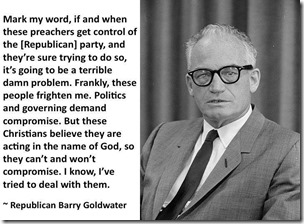
On Church and State Separation and Religion in Politics:

Religious persecution in England, a result of a combined church-state government, led to our ancestors fleeing Great Britain in the hopes of religious freedom. Some of these people voluntarily sailed to the American Colonies specifically for this purpose. After the American Revolution, the Constitution of United States was specifically amended to ban the establishment of religion by Congress.
bgoldwater
At the beginning of the Protestant Reformation, Martin Luther articulated a doctrine of the two kingdoms. According to James Madison, perhaps one of the most important modern proponents of the separation of church and state, Luther's doctrine of the two kingdoms marked the beginning of the modern conception of separation of church and state

“Congress shall make no law respecting an establishment of religion, or prohibiting the free exercise thereof, or abridging the freedom of speech, or of the press; or the right of the people peaceably to assemble, and to petition the Government for a redress of grievances” In English, the exact term is an offshoot of the phrase, "wall of separation between church and state", as written in Thomas Jefferson's letter to the Danbury Baptist Association in 1802. In that letter, referencing the First Amendment to the United States Constitution, Jefferson writes:
“Believing with you that religion is a matter which lies solely between Man & his God, that he owes account to none other for his faith or his worship, that the legitimate powers of government reach actions only, & not opinions, I contemplate with sovereign reverence that act of the whole American people which declared that their legislature should 'make no law respecting an establishment of religion, or prohibiting the free exercise thereof,' thus building a wall of separation between Church and State.”

republicants (3)
June 26, 1830 ‘assigned’ members of the United Baptist Church of Christ…In November of that same year the membership drafted and received their Abstract of Principles:
Article…12th We believe that a union of religion and states constitutes the antichristian kingdom.Article…13th We believe that the religion of Jesus Christ ought not, nor cannot be established by the civil law of the Land and further we believe that no Legislative body whatever ought to presume to pass any such law.
Article…14th We believe it to be our duty to support the Government under which we live in all her civil matters.
15th We believe that money was not the means that God devised in infinite wisdom to affect the spread of the Gospel.”     The church at Second Creek Meetinghouse in Lawrence County, Tennessee

Americans United for Separation of Church and State was founded in 1947 by a broad coalition of religious, educational and civic leaders. At that time, proposals were pending in the U.S. Congress to extend government aid to private religious schools. Many Americans opposed this idea, insisting that government support for religious education would violate church-state separation. The decision was made to form a national organization to promote this point of view and defend the separation principle.

Even This Guy Couldn’t Win a Republican Primary:

Jesuswas


Because…

republicanjesus

Unless We Re-Wrote The Bible:

wwjd


But This Guy Is The Current GOP Hero:


507

Search This Blog